Letters in Jane Austen’s Pride and Prejudice offer a deeper look into the core of Austen’s characters, as the letters act as pseudo-diaries for each character, portraying events in a light which the narration cannot capture due to the lack of omniscience in the text. Through the use of comprehensive word clouds of each of the full letters sent between characters in the novel (excluding small notes), the character description in the narration of the novel and the actions of the characters can be juxtaposed with the main ideas and words of the characters’ letters. This demonstrates whether the characters’ consistent actions really portray who they are, or if something else lies beneath their surface.
Word clouds make the best representation of the characters because even single words are so powerful, both in secondary character development (narration) and direct character action (speaking or dialogue). In pulling only the key words and ideas from the letters each of the characters writes, the key aspects of that characters core come to the foreground. Using this tool, one can remove the unnecessary, superfluous fluff from the outside of the character profile, and dive into the deeper aspects of the character; in this case, the letters used to make word clouds are considered directly indicative of the character who writes them.
The first letter sent from one character to another is Mr. Collins’s letter to Mr. Bennet, announcing Collins’s impending visit to Longbourn. Textually, Collins appears to be a rather uptight and pompous man, unafraid of continuously and relentlessly milking his relationship with the great and most high Lady Catherine de Bourgh. In his letters, Mr. Collins essentially puts forth the same front (though possibly more pompous and cocky). Of the 371 words in Mr. Collins’s first letter, some of the most common are “duty,” “lady,” “clergyman,” and “Catherine.” Clearly, Collins’s main goal in this letter is to show off his newly acquired status – more than introduce himself to the family, he wants to introduce his position, and though he’ll take over the Bennet estate when Lizzie’s father dies, Collins wants to give the impression that he cares whether the girls get any share in the estate after their father dies. Collins’s second letter (again to Mr. Bennet) doesn’t delve any deeper into his character – obviously a very shallow one at that. The 349-word letter features the words “dear” and “daughter” among the most common, with “Catherine” and “Collins” (in reference to his wife) also on the list. Once again, Collins has demonstrated through his letter that the pompous outside continues on to the inside as well. This time, Collins’s focus leans towards the new acquisition of his wife, and the loss the Bennet daughters have experienced following Elizabeth’s rejection of Collins’s proposal as well as the heinous grievance endured due to Lydia’s indiscretion. Collins becomes extremely patronizing, as the words “dear” and “sir” would suggest. Evidently, not only does Collins represent the single most shallow yet regularly featured character in his dialogue, his letters do little but to reaffirm his completely static character. In this case, the letters tell us what we would have already known.
Mr. Edward Gardiner, the Bennet girls’ uncle, writes letters that give new light to his character. Though we don’t see very much of Mr. Gardiner, this letter helps us to understand a soft spoken character with relatively little page-time. In the text, Mr. Gardiner seems to be a fairly nice man, without much to say or any outstanding character motivations. His letter tells a slightly different story. Mr. Gardiner seems to be a very family-oriented person, committed to making sure everyone in his family is informed as to the current situation, and safe in any and all situations which he can exact control over. All of the most common words in his letter (“niece,” “hope,” “send,” “married,” “particulars”) have to do with the specifics of Lydia’s situation – he wants the family to know exactly what the situation is even though none of them can be there. The same is true for Mr. Gardiner’s second letter. Once again, Mr. Gardiner’s rather introverted character is brought to light. Mr. Gardiner’s demonstrates that his greatest concern is ensuring that although Lydia may not have married into the best situation, she will still have the best possible life. This includes Mr. Gardiner doing everything he can to ensure that Wickham’s credit is clean, as the major words, such as “assurances,” “hope,” and “creditors” would suggest. In this instance, Austen does not as much contradict the character’s presence in dialogue and action as much as actually give the character a personality. Austen’s reluctance to really drastically change anything from the character to the letter demonstrates that keeping the family seem as stable (or, from another view, completely unstable) as possible. Something must remain constant amid the change surrounding Lizzy’s life.
Obviously, Lydia does not have the same consciousness for others that her sisters have; her letter mostly revolves around Lydia and what Lydia has done, is doing, and is feeling, and how she thinks everyone else will react to her situation. This is most likely a result of how her mother brought her up – to think of marriage and nothing else. In her second letter, Lydia once again demonstrates her selfishness isn’t purely a surface matter, but a deep characteristic of her most basic form. Even when her older sister is about to me married, Lydia’s letter focuses more on her own life and husband than congratulations for her dear sister. Where Collins’s letters build a breadth of pompousness, Lydia’s do the opposite – reveal the depth of her narcissism. Again, Austen writes the core characters with a measure of consistency; nothing truly surprising comes to light. However, it is important to note that some people really dislike this consistency in Austen’s work. For example, Ralph Waldo Emerson thought that her work was “sterile in artistic vision.” Clearly, the consistency in characters and plot didn’t please everyone (7 People).
Mr. Bennet sends one letter of which Austen reveals any of the text, and in its entirety has 46 words, and approximately one crap-ton (equivalent to 16 bucket loads) of sass. This letter sums up Mr. Bennet to a tee. He doesn’t mess around, he likes to be simple and quick, and if he can throw in a little sarcasm and sass somewhere, it’s all for the better. Truly, Mr. Bennet’s transparency stands as one of the most undeniable truths of the novel. In this case, Austen stays completely true to the character as portrayed in social interaction in the novel. Mr. Bennet doesn’t deal with anyone else’s baggage.
This letter, from Jane to Lizzy, very clearly illustrates the depth of feeling which characterizes Jane. The major words in her letter have to do with a feeling of anxiety, and are often related to her being the older sister, and feeling a measure of responsibility for her family’s and her own situation. She often tries to explain away others’ actions, and see the best in any given situation. None of the major words in any of Jane’s letters have anything to do with how Jane herself fares, but pertain to other people in the family. Jane’s letters have everything to do with Jane ensuring that everyone else has what they need. Jane generally forgoes telling Lizzy how she (Jane) is, and instead makes sure Lizzy is fully up to speed on recent events, as opposed to Jane venting her feelings to Lizzy. Everything revolves around everyone else for Jane, nothing revolves around Jane herself. As compared to Jane in the text, this actually is a little reversed. In speech, Jane is slightly more willing to talk to Elizabeth about her feelings in certain situations, although she almost never will with anyone else. However, during actual conversation Jane also spends a lot more time finding out about Lizzy’s feelings. Austen most likely spends more time worrying about Lizzy in Jane’s letters because in an actual conversation, Jane would spend much more time talking about Lizzy than herself.
Mrs. Gardiner often speaks up more than Mr. Gardiner, and for the most part seems to be a very caring aunt – possibly the one adult female role model in Jane and Lizzy’s lives who cares for their feelings rather than their being married. Her letter surely confirms that her personality in her small words and actions is indeed true. Though Mrs. Gardiner was not supposed to tell of the events that transpired around the time of Lydia’s marriage, she tells Lizzy anyway, just because Mrs. Gardiner knows that Lizzy is extremely eager to know the details, and just how much her family owes Mr. Darcy. In text, this is also the case. Once again, Austen goes out of the way to demonstrate that nothing has ever truly shaken Lizzy’s life up. Though dysfunctional, her family is constant, which makes the events of the novel that much more extreme. This idea is one of the many beauties of the novel, as Sir Walter Scott wrote in his journal about Austen’s work, “That young lady had a talent for describing the involvement and feelings and characters of ordinary life which is to me the most wonderful I ever met with” (Jane Austen’s Art). The absolute normality of the characters and the novel is what makes Austen’s storytelling so fantastic.
Of all the letters written in the novel, Darcy’s is the only one which demonstrates a major shift in character. Darcy realizes that one of Lizzie’s biggest issues with him lies in the supposed mistreatment of Wickham, so the letter focuses on that particular problem. Darcy himself places a large emphasis on family, though not necessarily seen in his actions, as can be interpreted from the fact that several of the most common words are those relating to family. As such, Darcy would do anything for his family, and anything for his love’s family to keep their standing. Before this moment, Darcy always seems to be haughty and above everyone else. His letter shows that he really wants to explain himself, he wants Lizzy to understand everything behind his motivation and love, and he can’t do that in a conversation. Through all of the consistency in the rest of the letters, this letter and its asymmetry mirror the source of the inconsistency in Lizzy’s life – Darcy himself.
Lizzy generally doesn’t send letters in this book, as her thoughts and feelings are most intimately known through Austen’s commentary. However, Lizzy’s letter sheds an interesting light on her character. Lizzy seems to be one of the most down to earth characters, and yet her major word is “world.” Perhaps she is, in fact, more of a dreamer than we might initially think, and really all she wants is her world to be a dream one. She really feels that she has the best life in the world, after she marries Darcy. As a direct compliment to Darcy’s letter, Lizzy’s shows not how her personality is different in the letter than in her commentary, but how her personality has changed since the beginning of the novel. Of all the letters, this proves to be the most revealing. From the beginning of the novel to Lizzy’s letter at the end, Lizzy develops from a hyper-realistic and cynical person to someone with the capacity to have a hyper-active sense of superlatives. If anything qualifies as fantastic, that had better. Austen uses a few characters with little variation in personality to supplement one girl’s transformation from realistic to less realistic, and people all over the world love her book. What else qualifies as success?
Through the use of letters in Jane Austen’s Pride and Prejudice and an analysis by way of word cloud, it can be determined that Austen’s novel does not have a cut-and-dry rule for how letters represent their writers. One thing, however, is definite: those characters who do write letters (with the exception of Darcy) find themselves accurately represented within those letters. Very little core differentiation occurs. Literarily, this represents the consistency in Lizzy’s life gained from her family members, and the resulting instability which entered her life at the same time as Darcy. Darcy changed Elizabeth’s life.
Works Cited
"7 People Who Hated Pride and Prejudice." Mental Floss. N.p., 3 Jan. 2013. Web. 16 Dec. 2013. <http://mentalfloss.com/article/32099/7-people-who-hated-pride-and-prejudice>.
Austen, Jane, and Donald J. Gray. Pride and Prejudice. New York: W.W. Norton, 1993. Print.
"Jane Austen's Art and Her Literary Reputation." Jane Austen's Art and Her Literary Reputation. N.p., n.d. Web. 16 Dec. 2013. <http://www.pemberley.com/janeinfo/janeart.html>.
Showing posts with label BRILLIANT. Show all posts
Showing posts with label BRILLIANT. Show all posts
Monday, December 16, 2013

Letters and Word Clouds in Pride and Prejudice

Clearly, Collins’s main goal in this letter is to show off his newly acquired status – more than introduce himself to the family, he wants to introduce his position to the family, and though he’ll take over the Bennet estate when Lizzie’s father dies, Collins wants to give the daughters a chance to atone for the terrible misfortune of the Bennets’ not having a son.

This letter, from Jane to Lizzy, very clearly illustrates the depth of feeling which characterizes Jane. The major words in her letter have to do with a feeling of anxiety, and are often related to her being the older sister, and feeling a measure of responsibility for her family’s and her own situation. She often tries to explain away others’ actions, and see the best in any given situation.

Darcy realizes that one of Lizzie’s biggest issues with him lies in the supposed mistreatment of Wickham, so the letter focuses on that particular problem. Darcy himself places a large emphasis on family, though not necessarily seen in his actions, as can be interpreted from the fact that several of the most common words are those relating to family. As such, Darcy would do anything for his family, and anything for his love’s family to keep their standing.

This letter particularly expresses Jane’s devotion to her family, and their issues, as opposed to just her own feelings in any matter. Notice how none of the major words have anything to do with how Jane herself is faring in light of this matter, but most pertain to other people in the family, or the situation as a whole.

Once again, this sequence of letters has much to do with Jane ensuring that everyone else has what they need, and knows everything going on. Jane once again forgoes telling Lizzy how she (Jane) is, and instead makes sure Lizzy is fully up to speed on the goings-on of the last few days. Everything revolves around everything else for Jane, nothing revolves around Jane herself.

Obviously, Lydia does not have the same consciousness for others that her sisters have; the letter mostly revolves around Lydia and what Lydia has done, is doing, and is feeling, and how she thinks everyone else will react to her situation. This is most likely a result of how her mother brought her up – to think of marriage and nothing else.

Once again, Collins has demonstrated through his letter that the pompous outside continues on to the inside as well. This time, Collins’s focus leans towards the new acquisition of his wife, and the loss the Bennet daughters have experienced following Elizabeth’s rejection of Collins’s proposal. He becomes extremely patronizing, as the words “dear” and “sir” would suggest.

Though we don’t see very much of Mr. Gardiner, the Bennet girls’ uncle, this letter opens up a character who doesn’t say very much in common conversation. Mr. Gardiner seems to be a very family-oriented person, committed to making sure everyone in his family is informed as to the current situation, and safe in any situation which he can control.

Once again, Mr. Gardiner’s rather introverted character is brought to light through his letter to his brother. Mr. Gardiner’s greatest concern in this letter is ensuring that although Lydia may not have married into the best situation, she will have the best possible life out of that situation. This includes Mr. Gardiner doing everything he can to ensure that Wickham’s credit is clean, as the more major words, such as “assurances,” “hope,” and “creditors” would suggest.

Mrs. Gardiner often speaks up more than Mr. Gardiner, and for the most part seems to be a very caring aunt – possibly the one adult female role model in Jane and Lizzy’s lives who cares for their feelings rather than their being married. Her letter surely confirms that her personality in her small words and actions is indeed true. Though Mrs. Gardiner was not supposed to tell of the events that transpired around the time of Lydia’s marriage, she tells Lizzy anyway, just because Mrs. Gardiner knows that Lizzy is extremely eager to know the details, and just how much her family owes Mr. Darcy.
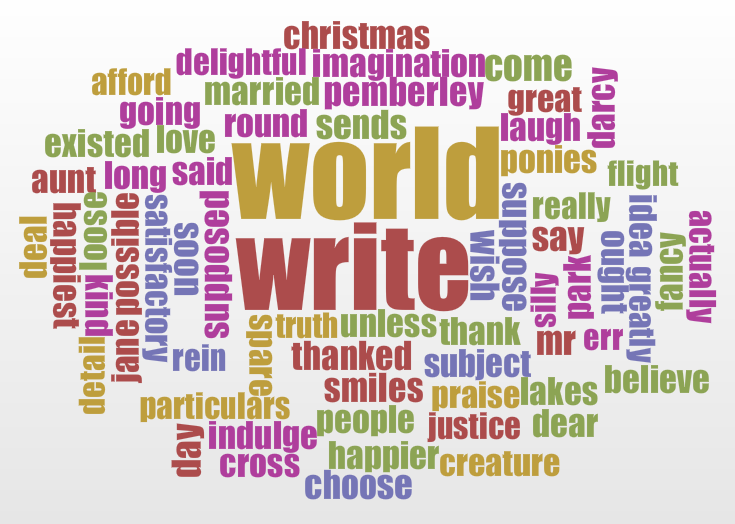
Lizzy generally doesn’t send letters in this book, as her thoughts and feelings are most intimately known through Austen’s commentary. However, this particular letter sheds an interesting light on her character. Lizzy seems to be one of the most down to earth characters, and yet her major word is “world.” Perhaps she is, in fact, more of a dreamer than we might initially think, and really all she wants is her world to be a dream one. She really feels that she has the best life in the world, after she marries Darcy.

This letter sums up Mr. Bennet to a tee. He doesn’t mess around, he likes to be simple and quick, and if he can throw in a little sass somewhere, it’s all for the better. Truly, Mr. Bennet’s transparency stands as one of the most undeniable truths of the novel.

Once again, Lydia demonstrates that her selfishness isn’t purely a surface matter, but a deep characteristic of her most basic form. Even when her older sister is about to me married, Lydia’s letter focuses more on her own life and husband than congratulations for her dear sister.
Thursday, November 7, 2013
A Touch of Cancer
Thus far into A Brave
New World, major themes are as yet still building, and for the most part
the key to the novel has remained elusive. However, the novel seems to be
highly interested in the negativity of individuality and personal identity. Social
continuity and homogeneity maintain themselves as society’s stability, and
individuality threatens the entity which is this World State.
The first instance which begins to explore the instrumentality
of stripping society of individuality comes in the very beginning of the novel,
when the students tour the Central London Hatchery and Conditioning Centre. The
new process for fertilizing eggs and then making embryos results in, for all
castes other than Alphas and Betas, results in “Making ninety-six human beings
grow where only one grew before. Progress” (Huxley 17). Syntactically, these
statements represent much of the philosophy of the society. It (the society)
does not need to be made up of “complete” individuals, ones with independent
mindsets, goals, and outlooks on life. Like these near-sentences, the people of
the society can carry out their function without having a full consciousness. This
encourages the retraction of individuality, and substitution with hive-minded
people, for the sake of a more efficient system. Much like the way Huxley uses
only fragments to describe the lack of genetic individuality within the World
State, the geneticists and breeders strip the people down to only the necessary
elements for their castes. Intelligence, psychological preferences and
predispositions, and social mindset are precisely engineered to ensure the
human contains only what is exactly necessary to give meaning to the situation,
but not enough for any extraneous meanings or opinions to form from the
information planted in that person.
Because the society actively puts down individuality, any
appearance of difference is heavily ridiculed. Even the individual who appears
or thinks differently than the rest of the society notices the difference, and
extreme self-consciousness of the difference results. Bernard Marx, while
intellectually equal to anyone else of the Alpha-Plus caste, is slightly
shorter than the rest of his caste, and as such feels out of place. Because of
this difference, “feeling an outsider he behaved like one,” directly characterizing
Marx as someone in direct conflict with the goal of the World State society
(69). In the case of the type of characterization Huxley employs to expose
Marx, the use of direct as opposed to indirect characterization supersedes the
importance of the explicit word choice of the statement. Though the others of
his caste and his general society have an awareness of the difference between
Marx and others conditionately equal to him, Marx has the greatest awareness of this difference. Marx internalizes his
difference from others, and even works to make it larger. He consciously
separates himself from the rigorous hypnopædia propaganda he was exposed to as
a child. He wants to get to know the women he sees, as opposed to having lots
of one night stands. His interests directly conflict with the society, and when
people see this, they look down on him, more so than they do simply because of
his physical “defect,” as it were. Any form of individuality maintains itself
as alien to this society.
Furthermore, this individuality greatly threatens the
society as a whole, whether Marx knows it or not. The society as a whole cannot
function properly if a member becomes different enough to challenge the norms,
although, as the Director states, “the social body persists although the
component cells may change” (95). Marx’s mentality and challenging of the norms
and hypnopædia represents something far more dangerous than simply a component
cell dying and being exchanged in the metaphorical body of the World State.
Newness of thought, innovation of opinion and tradition have the potential to
spread like a cancer through this society, destroying it from the inside.
Truly, the most dangerous occurrence for this society lies in the possibility
that hypnopædia could be overcome, and the past freedom of thought come back.
Especially dangerous, because the only people physically capable of this kind
of thought are in the upper castes, and as a result, the differences in thought
would manifest in the most important parts of the proverbial body, the
reproductive system, the brain, the vital organs. A cancer of the support
system of the body, the lower castes that keep the infrastructure going, a bone
or skin cancer that is slow growing and not quick to metastasize, that can be
cut out, cut off, and the body can keep going. But, when a cell in the brain,
in the heart, in the major systems of the body becomes cancerous and begins to
spread and grow, to overtake the mother organ and then move to others, it takes
down the whole body, cannot be removed because as surely as the cancer will
kill the body, so would the surgery necessary to remove it. This cancer is
fatal. Huxley points out that even when highly conditioned, individuality, social
cancerousness exists; to a society completely reliant on uniformity and the
stripping of individual identity, the danger this cancer poses is real, and
could spread to Stage IV before the body even realizes it’s there. (859 words)
Subscribe to:
Posts (Atom)